Understanding Division 296 from what we know by Graeme Colley

Introduction:

Graeme Colley, who is a well-known expert in SMSFs and the Cloudoffis Independent Consultant, has provided an update on the latest developments for Div 296.

Understanding Division 296 from what we know

The reworked Division 296 legislation, Treasury Laws Amendment (Building a Stronger and Fairer Super System) Bill 2026, finally made it to parliament in February this year after going through many changes since it was announced in the 2023-24 Federal Budget. The main changes in the bill are a move away from taxing unrealised capital gains and the indexation of the thresholds. There are a number of other important changes that have taken place and should be understood if the legislation finally makes it into law.

The current bill continues to reduce superannuation tax breaks for anyone with a total super balance of more than $3 million and places an additional impost on those with balances of more than $10 million. An individual’s realised fund earnings from 1 July 2026 is taxed if their total super balance for Division 296 purposes is above the relevant threshold.

The main features of the bill are:

  • The legislation is proposed to commence on 1 July 2026 rather than 1 July 2025 as originally proposed.
  • For anyone with a superannuation balance of $3 million or more the tax will be a maximum of 15% of the realised income for the relevant financial year. If a person has a superannuation balance of $10 million or more there is an additional impost of 10% on the realised income.
  • The realised income is based on income tax principles rather than the concept in the original proposal which taxed the difference between the individual’s opening and closing superannuation balances for the year. It is calculated at the fund level and an amount is attributed to the relevant member. For an SMSF it is expected an actuary will make the calculation.
  • Trustees of SMSFs will have the option of resetting the cost base of the fund’s investments as at 30 June 2026 to recognise the level of accrued value in the investment to that time. The option is only available on all of the fund’s investments and applies only for purposes of Div 296.
  • The calculation of Div 296 tax consists of three stages:

    • Stage 1 – Percentage formula (s 296-40(2))
    • Stage 2 – Div 296 fund earnings (s 296-45(2))
    • Stage 3 – Taxable superannuation earnings (s 296-40(1))
  • Division 296 tax is levied on the individual who has the option of paying the tax from their own resources or having the superannuation fund pay the liability.

Stage 1 – the percentage formula

The percentage formula determines the proportion of a person’s balance that is above each of the thresholds. There is one formula for calculating the proportion above $3 million and another which calculates the proportion of a person’s balance above $10 million.

The formula that applies where the person’s total superannuation balance is at least $3 million is:
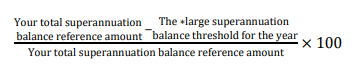
Where:

The total superannuation balance reference amount is the greater of a person’s total superannuation balance (if any):

• just before the start of the year; and

• at the end of the year.

The large superannuation balance threshold is $3 million (or indexed threshold) for the year.

Note: for the 2026-27 financial year (the first year of operation) the year end figure will be used in the calculation.

The examples of Judi and Brad illustrate how Division 296 tax will be calculated for someone who has a total superannuation balance of greater than $3 million in the case of Judi and in the case of Brad, $10 million.

Example

Judi has a Total Superannuation Balance (TSB) of $4 million on 30 June 2027 and a TSB of $3.5 million on 30 June 2026. Her total superannuation fund earnings for the year is $100,000 which means she will have a tax liability for Division 296 purposes.

As Judi’s TSB on 30 June 2027 is $4 million it will be used to calculate the percentage of her TSB that is over and above her large superannuation balance.

The proportion of Judi’s TSB above the $3 million threshold is 25% which is calculated as:

Total Superannuation Balance above $10 million

The second formula which is used to calculate the additional tax impost on TSBs above $10 million is:

Where:
The total superannuation balance reference amount is the greater of a person’s total superannuation balance (if any):

• just before the start of the year; and

• at the end of the year.

The very large superannuation balance threshold is $10 million (or indexed threshold) for the year.

Note: for the 2026-27 financial year (the first year of operation) the year end figure will be used in the calculation.

Example

Brad has a TSB of $12 million as at 30 June 2027 and a TSB of $10.5 million on 30 June 2026. His total superannuation fund earnings for the year is $1,000,000 which means he will have a tax liability for Division 296 purposes. As Brad’s TSB is greater than the very large superannuation balance of $10 million he will be required to pay additional tax.

The proportion of Brad’s TSB above the $3 million threshold is 75% which is calculated as:

The proportion of Brad’s TSB which is above the $10 million threshold is 16.67% which is calculated as:

Stage 2 – Div 296 Fund earnings

Stage 2 determines the fund earnings for Division 296 purposes which is calculated at the fund level not the member level. Once the fund earnings has been determined a further calculation is made to work out the amount of fund earnings that applies to the member. At this stage (as at 19 February 2026) the method used to calculate the member amount is not available as it will be included in the regulations if the bill becomes law.

The formula to determine the fund earnings is:
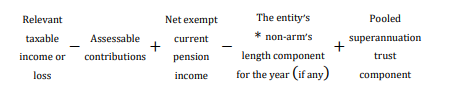
Where:

Relevant taxable income or loss is the fund’s taxable income for the year,

Assessable contributions are the taxable contributions included in the fund’s income for the year,

Net exempt current pension income is the fund’s exempt income less the total deductions if the exempt income was assessable income.

The entity’s non-arm’s length component for the year (if any) is the amount of income that is taxed as NALI by the fund.

Pooled superannuation trust component applies if the fund has an investment in such a trust.

Example – Judi

Using the example of Judi above the fund’s taxable income is $350,000, assessable contributions claimed by the fund are $60,000 and the fund’s net current pension income less expenses is $310,000. The fund does not have any non-arm’s length component or investments in a pooled superannuation trust. Therefore the fund earnings for Division 296 purposes is $600,000. It is determined by an actuary (as proposed) that the proportion of the Div 296 fund earnings attributable to Judi is $100,000.

Example – Brad

The Div 296 fund earnings attributable to Brad has been calculated as $1,000,000.

Stage 3 – Taxable superannuation earnings

Taxable superannuation earnings is calculated as:

The percentage amount ×the Div 296 fund earnings

which involves multiplying the percentage amount from Stage 1 by the Div 296 fund earnings calculated in Stage 2.

Example – Judi

Judi’s taxable superannuation earnings is calculated as:

25% ×$100,000=$25,000

The amount of tax payable on Judi’s large superannuation balance is:

$25,000 ×15%=$3,750

Example – Brad

Tax on Brad’s large superannuation earnings

Brad’s taxable superannuation earnings is calculated as:

$1,000,000 ×75%=$750,000

The amount of tax payable on Brad’s large superannuation earnings is:

$750,000 ×15%=$112,500

Tax on Brad’s very large superannuation balance earnings

Brad’s very large superannuation earnings is calculated as:

The percentage amount ×the Div 296 fund earnings

The percentage amount on Brad’s very large superannuation earnings is 16.67% and Brad’s superannuation earnings is $750,000. Therefore the amount of tax payable on Brad’s very large superannuation balance is:

16.67% ×$750,000=$125,025

The amount of tax payable on Brad’s very large superannuation earnings is:

$125,025 ×10%=$12,502.50

The total Div 296 tax payable by Brad will be:

$112,500+12,502.50=$125,002.50

The Treasury Laws Amendment (Building a Stronger and Fairer Super System) Bill 2026 is yet to be debated in both houses of the parliament which may result in a number of changes if the legislation is passed and becomes law. Also, as the regulations will not be made until the legislation is passed there are some aspects which are not known at this stage as indicated above. Therefore the examples above are based on the bill and indicative of how Division 296 will operate.

Want to know more?

Graeme recently hosted a webinar on this topic which you can watch here.

We will also be hosting more webinars and events with Graeme in the coming months.



The Cloudoffis Bulletin – December Edition

Welcome to the last Cloudoffis Bulletin of 2025! The team at Cloudoffis wishes our wonderful community a restful and enjoyable break over the holidays.

This month, we have a jam-packed newsletter for you – featuring some really insightful updates from industry expert Graeme Colley and some great content featuring Tyler Caskey and Heather Smith. Sit back and enjoy this read.

We look forward to catching up with many of you in the coming weeks.

Latest News

Reimagining workpapers with an industry expert Tyler Caskey

Get your Workpapers Sorted with Cloudoffis

If your workpaper process could use some efficiencies as you head into 2026, learn more about how one of our customers, Paul Money, transformed his workpaper process with Workpapers Sorted, by Cloudoffis.


Enjoy this special demo with Heather Smith

If you like what you see, you can book a personalised demo with the team today.


A special event in Sydney

Thank you to our wonderful community for joining the team for our last event of 2025! It was a pleasure to invite our partners, customers, and industry experts for an evening of insights and celebration.

We look forward to welcoming you at more events in 2026!

SMSF Death Benefits Checklist

When we host our quarterly Ask Graeme webinars, one question which always arises is around the topic of SMSF death benefits. Our team worked with Grame Colley on putting together this checklist to help you and your clients ensure you are asking the right questions on this topic.


An update on Division 296, by Graeme Colley

Division 296 has been a hot topic this year, and with recent updates to this legislation

we got an update from industry expert Grame Colley on what this means for you.


What’s new with Workpapers Sorted

Improved FYI Document Upload Experience 🙌

We’ve added clear file-type icons within the FYI Document screen, making it easier to identify and select the correct format when uploading documents for your workpapers.

Client Tax History at a Glance 📘

A new “Lodged as per ATO” column is now available in the Job Financial Reports screen.

This displays the past four years of lodged Income Tax Return information, giving preparers immediate visibility of the client’s history in a single view—supporting more accurate workpaper preparation and tax return reviews.

Enhanced Workpapers

We’ve made a series of improvements across our workpapers to ensure more reliable and accurate calculations, along with the addition of new workpaper templates to support a broader range of scenarios. (Accounts Receivable, Accounts Payable, Depreciation Schedule as per Accounts)

Coming in December:

New PDF Workpaper Package Format 🙌

  • We’re introducing a redesigned PDF package for workpapers.

  • The new format focuses on readability and review efficiency, helping preparers and reviewers navigate documentation more easily during the finalisation process.

Excel File Viewer in the Document Section

  • Excel uploads in the document section will soon open directly in an Excel-style view rather than converting to PDF.

  • This improvement ensures better clarity and preserves the original structure of your spreadsheets.


Are you ready to grow with Cloudoffis?

Whether your practice specialises in auditing or offers a full suite of accounting and advisory services, Cloudoffis has you covered with streamlined workpapers and workflows. Cloudoffis is here to help keep your practice running smoothly.

  • Quick Setup – Get started in minutes

  • Flexible Platform – Work the way you want with adaptable features and integrations

  • AI, Cloud-Based Technology – Delivering efficiencies and compliance at scale

  • Flexible Pricing & Unlimited Users – No lock-in contracts

  • Free Onboarding & Ongoing Training – Onboard your team effortlessly with expert guidance and continuous support at no extra cost

  • Tailored Solutions – Our agile team adapts to your unique business needs to ensure your success


Graeme’s Super News - A look back on SMSF in 2025

Graeme’s Super News – A look back on SMSF in 2025

Read the latest updates from Graeme Colley, a respected educator, policy advisor, and technical expert with over 30 years' experience in taxation and superannuation.

In Graeme’s final update of 2025 – he reflects back on 2025 while adding some thoughts to what 2026 may hold.

Welcome to the end of another year and our last newsletter for 2025. This year has given us some possible changes to super, rulings from the regulators and greater obligations for super fund auditors.

Giving the gift of super

But seeing it’s the festive season and a time of giving, why not give a gift that lasts the test of time, like super. Give yourself a Christmas present by making personal contributions to super, increasing your salary sacrifice or helping family members boost their retirement savings. While contributions to super may not have an immediate impact, they may actually give a substantial long-term benefit.

Good fund administration

When looking back at the year, the main super issues centre on maintaining good fund administration. This includes making sure pensions are paid correctly and that auditors carry out
their professional duties properly.

An important change to anyone receiving a pension is to make sure that at least the minimum amount is paid. Failure to meet this requirement results in the pension ceasing from the start of that financial year, and all payments being treated as lump sums. Anyone wishing to recommence the pension must go through the process of starting a new pension in the next financial year with entirely new documents as well as calculations.

Underpaying the pension means additional income tax for the fund, as the amount supporting the pension will be treated as being in the accumulation phase for the year of the underpayment. Also, there may be transfer balance cap issues when the pension is stopped and if a new pension commences. One good way of making sure at least the minimum amount is paid can be to arrange for direct debits from the fund accounts to the pensioner. That way, there is a greater risk of the pension complying with the rules.

Something for auditors

For auditors, this year provided a number of salient lessons from the regulators and the courts as they took a tougher line on the need to maintain records and gather appropriate evidence in support of the auditor’s conclusions. Failure to meet these requirements resulted in many auditors being disqualified to audit an SMSF.

If you’ve been in this position before and are looking to avoid this in 2026, you should consider speaking to the team at Cloudoffis, whose technology helps maintain records in the cloud.

Division 296

The reannouncement of Division 296 tax on the increase in super balances above $3 million raised it’s head again. However, changes were made due to the reaction of the public and professional associations. The result was a rework of the basic proposed rules to include a second threshold of $10 million, indexation of the thresholds as well and including only realised gains in the calculation.

It is expected that the Division 296 proposal will show its head again early next year and be passed in time for it to commence on 1 July 2026. It will be interesting to see whether it will make it into law and how the changed proposal will operate.

Payday Super

Unlike the Div 296 tax, Payday Super is law and will commence from 1 July 2026. That legislation requires employers to pay super contributions at the same time as an employee’s salary and wages. In view of the effort required by employers to upgrade their payroll systems, the legislation provides a transitional period to comply with the new law. A draft of the ATO’s compliance approach in the first year of Payday Super for the 2026/27 financial year is published in PCG 2025/D5.

So summing up, it’s been another challenging yea,r and next year looks like it will be no different as we do our best to comply with the continuous changes in super. All the best for the holiday season.

Are you ready to grow with Cloudoffis?

Whether your practice specialises in auditing or offers a full suite of accounting and advisory services, Cloudoffis has you covered with streamlined workpapers and workflows. Cloudoffis is here to help keep your practice running smoothly.

  • Quick Setup – Get started in minutes
  • Flexible Platform – Work the way you want with adaptable features and integrations
  • AI, Cloud-Based Technology – Delivering efficiencies and compliance at scale
  • Flexible Pricing & Unlimited Users – No lock-in contracts
  • Free Onboarding & Ongoing Training – Onboard your team effortlessly with expert guidance and continuous support at no extra cost
  • Tailored Solutions – Our agile team adapts to your unique business needs to ensure your success


Graeme’s Super News - November Edition

Graeme’s Super News – November Edition

Read the latest updates from Graeme Colley, a respected educator, policy advisor, and technical expert with over 30 years’ experience in taxation and superannuation.

Welcome to some of this month’s roundup of key developments with SMSFs. From ATO compliance initiatives to ASIC audit reviews, make sure you’re up to date.

ASIC Flags Auditor Independence Breaches

ASIC recently released Report 817 – Building trust: Auditor compliance with independence and conflict of interest obligations. The report followed ASIC enforcement action taken against several auditors and firms identified as not meeting the independence and conflict of interest requirements.

Nearly one-third of the 48 auditors reviewed breached the mandatory independence requirements. Nine auditors failed to meet rotation requirements for 14 listed clients, and five held prohibited relationships under the Corporations Act. These breaches were found across all sizes of audit firms reviewed.

The source of the breaches was due to poor systems, lack of policies, carelessness, and inadequate quality control. ASIC considered that many auditors adopted a narrow, “tick-box” approach to compliance and failed to consider threats to independence or changing circumstances during audits. Some relied on inappropriate safeguards and did not document how they assessed independence risks.

Examples of threats included excessive non-audit fees—sometimes five times higher than audit fees—and long-standing relationships between auditors and clients, some lasting up to 36 years. ASIC emphasised that independence is fundamental to audit quality and encouraged all auditors to strengthen their practices and policies.

ATO Cracks Down on Late SMSF Lodgements

The ATO is taking a tougher stance on late lodgement of SMSF annual returns. About 10% of 2022/23 returns remain outstanding, and similar figures are expected for 2024. The ATO’s experience is that late lodgement often signals illegal early access or other compliance issues.

Consequences for late lodgement include removal of the fund from Super Fund Lookup, which restricts contributions and rollovers, and potentially may result in trustee disqualification.

Continued non-lodgement may trigger harsher penalties. The ATO advises trustees to respond promptly to any ATO correspondence and avoid ignoring compliance letters.

Trustee Declaration Requirements Clarified

Since 2007, SMSF trustees have been required to complete the ATO trustee declaration within 21 days of appointment and retain it for at least 10 years. Auditors are required to sight the original declaration and keep a copy in their audit file, along with annual confirmations that trustees continue to retain it.

However, many auditors only review copies and request new declarations when originals are lost. The ATO has clarified that if the original cannot be sighted, a new declaration must be signed. A once-off breach can be rectified, but repeated failures require an Auditor Contravention Report (ACR).

Auditors should not be lodging ACRs annually for the same fund due to missing originals if the breach has been rectified.

Market Valuation Breaches Increasing

Breaches of regulation 8.02B of the SIS Regulations, which requires SMSF assets to be valued at market value, accounted for 12% of all reported breaches in 2024–25. Trustees must ensure that valuations for each income year are accurate, in line with the ATO’s valuation guidelines and provide supporting evidence to auditors.

The ATO is using data analytics to identify funds which have reported unchanged asset values year after year, raising concerns about compliance. Failure to meet valuation requirements can result in additional tax liabilities and administrative penalties.

Auditors must assess whether the valuation basis is appropriate and document their findings. Trustees are reminded to provide objective, supportable evidence, including all documents requested by auditors.

SMSFs Failing to Respond to Release Authorities

The ATO has seen a rise in SMSFs failing to respond correctly to release authorities—documents authorising the release of funds to pay liabilities such as excess contributions, Division 293 tax or possibly Division 296 tax in future. Trustees must release the requested amount and submit a release authority statement within 10 business days of receipt.

Non-compliance can lead to significant penalties. Trustees should regularly check secure mail channels, set reminders, and use SMSF software to track deadlines. Working closely with administrators or tax agents can help ensure timely and accurate responses.

Keeping fund contact details, including electronic service addresses, up to date is essential for receiving important correspondence.

Surge in Compassionate Release of Super

Applications for compassionate release of super (CRS) have surged, particularly for dental treatments. Requests rose from 56,400 in 2021–22 to 90,700 in 2024–25, with costs reaching $104.4 million. Most applicants were aged 34 to 60.

The ATO, in collaboration with AHPRA, is concerned about practitioners supporting inappropriate access, especially for cosmetic procedures. Release on compassionate grounds is only available in limited circumstances, such as treating acute pain or life-threatening conditions, and requires certification from two practitioners.

Practitioners have been warned against providing financial advice without a licence and must ensure medical reports are accurate. New guidance from AHPRA and the Dental and Medical Boards emphasises that treatments should only be certified if necessary.

Writing Off SMSF Loans Requires Documentation

Writing off loans in SMSFs is being scrutinised by the ATO for breaches of the sole purpose test. Trustees need to demonstrate reasonable efforts to recover funds, including legal advice or evidence of insolvency. Without proper documentation, the ATO may see the transaction as illegal early access.

SMSFs generally cannot claim bad debt deductions unless they are in the business of lending. A capital loss may be claimed if the loan was made with a reasonable expectation of repayment.

If a member illegally accesses super, the funds cannot be returned, and any repayment to the fund will be treated as a new contribution. Trustees may face section 65 penalties, civil and criminal sanctions, disqualification, and fund non-compliance. Early access also breaches preservation standards, making the amount assessable income for the member.

Thank you for reading this months’ update.

If you are looking for more SMSF insights, you can watch Graeme’s latest webinar on demand here.


The Cloudoffis Pulse - Product Updates

Welcome to our first-ever Cloudoffis product newsletter – Cloudoffis Pulse, where we bring you the latest product updates across Workpapers Sorted, SMSF Auditomation and SMSF Sorted.

This month, we’ve some really exciting updates to share with you. Our incredible product team has been working hard to build the products you’ve asked for.

We hope you enjoy this update

From the product desk:

We are pleased to announce that Cloudoffis has successfully attained ISO 27001 certification. At Cloudoffis, safeguarding your data is our top priority. We are proud that we have achieved ISO 27001 certification, the internationally recognised standard for information security management systems (ISMS).

You can learn more about this here.


Book time with your Account Manager:

If you’re looking to elevate your Cloudoffis experience, book 30 minutes with Jocelyn or Dilnar today.

Meet Jocelyn Meet Dilnar

SMSF Death Benefit Checklist

Introduction:

When a member of an SMSF dies a death benefit may become payable to dependents. Also, if the deceased was an individual trustee or director of the corporate trustee a replacement may be required to ensure the fund can continue to operate and benefits are paid.

Here are some questions which may assist to ensure the correct documents are in place and decisions have been made to support the death benefit payment and the replacement of the trustee.

Depending on the client’s situation and the trust deed, there may be many more questions in addition to those below.

Notification of the Member’s death

  1. Has the trustee been notified of the death of a member or trustee?
  2. Has the trustee received a copy of the death certificate of the deceased or other official recognition of the death of the member or trustee?

Trust deed provisions

Do the governing rules of the fund, such as the fund’s trust deed, have any special requirements in relation to the death of the member or trustee?

Do the governing rules require replacement of the deceased member/trustee or member/director of the corporate trustee with the deceased’s legal personal representative (LPR) before a decision can be made about the payment of the deceased member’s death benefit?

Trustees

  1. Did the fund consist of a single member and a corporate trustee where the single member was the sole director of a corporate trustee?
  2. Did the fund have a corporate trustee and two directors who died simultaneously?
  3. Does the fund have one trustee or director of the corporate trustee who is living?
  4. If the sole director or the directors of a corporate trustee has died the company constitution may provide instructions on how the director is replaced.
  5. Did the deceased have a last will and testament which appointed an executor of their estate who can act as their legal personal representative (LPR)?
  6. If there is no will or LPR, have dependants or those who consider they have a claim to the superannuation of the deceased applied to the court for letters of administration. Has the Court granted letters of administration or is it in progress?

Death benefit powers of attorney and nominations

  1. Did the deceased grant an enduring power of attorney to a person or persons who are acting as the LPR of the deceased?
  2. Did the deceased make a death benefit nomination prior to their death?
  3. Is the death benefit nomination valid in terms of the fund’s governing rules and the law?
  4. Was the death benefit nomination binding or non-binding on the trustee?
  5. If the death benefit nomination is binding, the trustee is obliged to distribute benefits as instructed by the deceased.
  6. If the death benefit nomination was non-binding the trustee may use discretion to distribute benefits as provided in the nomination. However, they are not obliged to distribute benefits as provided in the non-binding nomination.

Payment of death benefit lump sums and pensions

  1. Have dependants of the deceased as at the date of the member’s death been identified for purposes of the SIS Act and Regulations?
  2. Was the deceased in receipt of a pension at the time of their death which provided a reversion to a dependant?
  3. Did the deceased make a valid reversionary pension nomination in accordance with the governing rules of the fund?
  4. Has the trustee made a decision concerning the distribution of death benefits to the dependants of the deceased or to their estate via their LPR?
  5. Are the member’s death benefits required to be paid as lump sums or pensions?
  6. Has more than an interim and final payment been made to the dependant as a lump sum?
  7. Was a pension payable to the surviving spouse if the deceased and surviving spouse were both under age 60 at the time of the member’s death? If so, tax is payable on taxable component of the pension until the surviving spouse is age 60.
  8. If pensions were payable to children of the deceased who are under 18 has the child’s LPR or guardian been identified to receive the payment on the child’s behalf?
  9. Have lump sums payable to the executor of the member’s estate been distributed in accordance with the will of the deceased?

Have trustee minutes and resolutions been made concerning the member’s death, appointment of trustee and payment of benefits to dependants or the member’s estate?

Has the trustee received confirmation of receipt of death benefit or commencement of a death benefit pension by the dependant and/or the estate of the deceased, as relevant?

Have the trustees notified the ATO concerning the amount of tax to be paid in respect of the taxable component of any death benefit lump sum paid to persons who are not death benefit dependants, for example, adult children of the deceased?

Cloudoffis makes preparation, approvals and compliance easy with AI-powered workpapers. As Australia’s leading SaaS provider in the SMSF industry, we bring over 9 years of unparalleled experience.

Pioneers in our field, we take pride in supporting the accounting and auditing community to streamline their workflows and work more efficiently through SMSF Sorted, SMSF Auditomation and Tax Sorted.