Sydney, 22 October 2026:
Australia’s SMSF audit workload is increasingly concentrating in the months leading into EOFY, as growing audit volumes, longer turnaround times and rising evidence requirements place greater pressure on practices, according to the inaugural SMSF Audit Crunch Report from Cloudoffis.
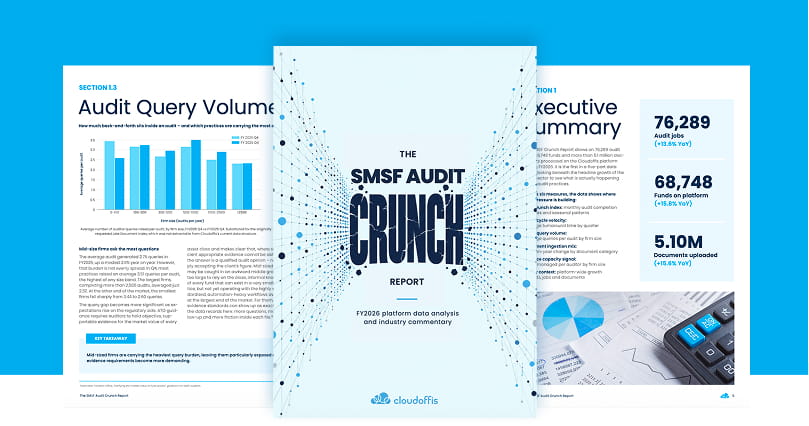
Drawing on 76,289 audit jobs, 68,748 SMSFs and more than 5.1 million documents processed through the Cloudoffis platform during FY2026, the report provides a new view into how the workload of SMSF audit practices is changing as the sector continues to expand.
The data shows May was the busiest month of FY2026, with 8,939 audits completed – 11.7 per cent of the entire year’s volume. More broadly, autumn accounted for 31.6 per cent of annual audit completions, compared with just 24.3 per cent during spring, showing the industry’s operational peak is clustering much closer to EOFY than the October SMSF annual return deadline.
At the same time, audit jobs processed through the platform increased 13.6 per cent year-on-year, while the number of funds rose 15.8 per cent and document uploads increased 15.6 per cent to 5.1 million.
Cloudoffis co-founder Manish Sheladia said the findings showed the SMSF audit capacity challenge was about more than simply rising fund numbers.
“For a long time, the industry has tended to think about workload around the familiar statutory deadlines. What the data shows is that the real operational crunch is happening later, with significantly more work concentrating in autumn and particularly in May,” Sheladia said.
“That matters because practices aren’t just dealing with more audits. They’re dealing with larger audit files, increasing evidence requirements and a growing SMSF sector at the same time.
“If firms are still planning their capacity around a spring peak, there is a risk they are preparing for the wrong crunch.”
The report found the impact of higher volumes is also flowing through to audit turnaround times. Average time from engagement to sign-off was lowest during the October to December quarter at 19 days, before increasing to 24.2 days in the April to June quarter. For SMSFs worth more than $10 million, the Q4 average reached 28.5 days.
Audit market increasingly operating at two speeds
The report also identifies a striking divide in capacity across SMSF audit practices.
Firms completing more than 2,500 audits a year managed an average 2,164 funds per auditor, compared with just 37 funds per auditor among practices completing fewer than 100 audits – a difference of almost 60-fold. Across the Cloudoffis dataset, 220 auditors managed 76,281 funds, or an average 346.7 funds per auditor.
Sheladia said the gap points to structural differences in how SMSF audit is being delivered.
“A 60-fold difference cannot be explained by individual productivity alone. It reflects very different operating models across the profession, including the extent to which firms have standardised processes, adopted technology and built the infrastructure to handle audit work at scale.
“It is also occurring as the market consolidates. As smaller or less active auditors leave the profession, those SMSFs still need to be audited, which means more work has to be absorbed elsewhere.
“The opportunity for smaller practices is that scale does not necessarily have to mean becoming a large firm. The same technology and standardised workflows available to enterprise practices can increasingly give smaller firms the ability to process more work without simply adding people at the same rate.”
The pressure is particularly evident among mid-sized practices. Across FY2026, the average audit generated 2.75 queries, but firms completing between 500 and 1,000 audits recorded the highest Q4 query burden, at 3.51 queries per audit. By comparison, firms completing more than 2,500 audits averaged 2.32 queries.
The report suggests these firms may be caught between the close client knowledge possible within very small practices and the more highly standardised and automated workflows available at greater scale.
Bigger audit files add to capacity pressure
The volume of evidence flowing through audit practices is also growing. Cloudoffis recorded a 15.6 per cent increase in documents uploaded during FY2026, from 4.4 million to 5.1 million. Expense documents alone reached approximately one million, representing 20.1 per cent of all documents processed and increasing 21.1 per cent year-on-year. Audit reports and letters recorded the fastest growth of any category, increasing 40.2 per cent from a smaller base.
Sheladia said this growth was important because each additional piece of evidence still needs to be ingested, classified and considered as part of the audit process.
“The challenge for practices is that volume compounds. More SMSFs mean more audits, more audits mean more documents and queries, and when that work concentrates into the same part of the year, turnaround times start to stretch.
“Technology has an important role to play, but this isn’t simply a technology problem. Practices need to think about when work enters the business, how complex files are triaged, how evidence is requested and how consistently work moves through the audit process.”
Growing sector faces greater scrutiny
The findings come as Australia’s SMSF sector continues to expand. ATO figures cited in the report show the sector reached 672,805 SMSFs and almost 1.24 million members by March 2026, holding an estimated $1.06 trillion in assets.
Growth is coinciding with increased regulatory scrutiny. The report notes the ATO completed 191 SMSF auditor compliance reviews during FY2025-26 and referred 39 auditors to ASIC, while regulators continue to focus on areas including asset ownership, existence and valuation evidence.
With Division 296 increasing the importance of current and supportable asset valuations, Sheladia said the next audit peak could bring both greater volume and greater compliance complexity.
“FY2027 is shaping up as an important test for the profession. The sector is getting bigger, expectations around evidence and valuations are increasing, and our data shows capacity is already distributed very unevenly.
“The message from the first SMSF Audit Crunch Report is not that firms simply need to work faster. It is that they need to understand where the pressure is building and design their processes around it before the next peak arrives.”
The SMSF Audit Crunch Report is the first Cloudoffis data series examining activity within Australian SMSF audit practices. The inaugural report analyses FY2026 platform activity across audit volumes, seasonal workload, turnaround times, query volumes, document processing and practice capacity.
For more information, please visit: https://cloudoffis.com.au.
ENDS
About Cloudoffis
Founded in 2017, Cloudoffis is a cloud-based technology provider for accounting and advisory firms in Australia, delivering AI-powered workpapers and workflow solutions that improve standardisation, efficiency and compliance. Cloudoffis supports more than 2,000 practices and over 100,000 funds as they move towards more connected, digital ways of working. By integrating with leading platforms including Class, BGL, Xero, Microsoft Excel, FYI and the ATO, Cloudoffis helps practices eliminate manual processes and focus on higher-value client work.